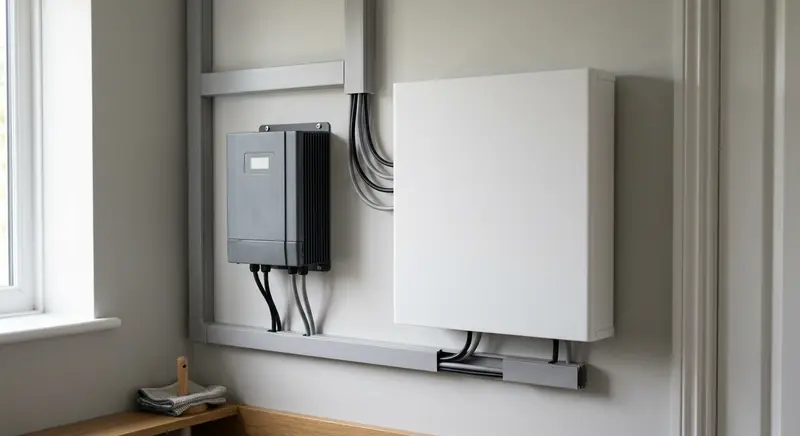
A home battery and inverter mounted on a utility room wall in Scotland
Honest Comparison

Solar With Battery vs Without — Scotland 2026

A battery lets you use more of your own solar power and, on a smart tariff, charge overnight for use at peak times. Without one, surplus solar is exported. What this means for your home is assessed at survey and confirmed on your written quote.
MetricWith BatteryWithout Battery
How it helpsStores surplus solar for later and, on a smart tariff, can charge overnight for use at peak timesSurplus solar is exported to the grid
Power cut protectionAvailable on backup-capable modelsNo — grid-dependent
CostPriced at surveyNo additional cost
FiT paymentsProtected with AC-coupled retrofitUnaffected
Export paymentsLess surplus to exportSmart Export Guarantee payments, with rates set by each supplier

Sources: MCS installation standards; Ofgem Smart Export Guarantee information.

0141 230 0198
Benefits

Why Add a Battery to Your Solar?

A retrofit battery helps you get more from an existing solar system. Here's how.

SunPVInvHomeBatGrid

Use More of Your Solar

Without a battery, surplus solar energy is exported. A battery lets you use it yourself later in the day instead.

Use Less Peak-Time Grid Power

Store solar daytime generation and cheap overnight power to reduce what you buy from the grid at peak rates.

Monitor via App

Track live generation, storage and consumption from your phone. Know exactly where your energy comes from and where it goes.

Power Cut Protection

Many of our batteries include blackout backup — your lights, router, and fridge stay on even when the grid goes down.

Reduce Your Carbon Footprint

Using more of your own solar power reduces the grid electricity you need to buy.

FiT & SEG Safe

AC-coupled retrofit preserves your Feed-in Tariff generation metering without modification. Your SEG export arrangement is unaffected.

Battery Options

Fully Installed Battery Systems

Every system is priced at survey and confirmed on your written quote, including supply, installation, commissioning and 0% VAT. Bird proofing included as standard on every install.

Hanchu
5.7 kWh
Priced at survey
  • 5.7 kWh usable capacity
  • LiFePO4 chemistry, 95% DoD
  • AC-coupled retrofit
  • App monitoring included
  • 0% VAT applied
Suitable for 1–3 bed homes with a 2–4 kWp solar system
Hanchu
11.4 kWh
Priced at survey
  • 11.4 kWh usable capacity
  • LiFePO4 chemistry, 95% DoD
  • AC-coupled retrofit
  • App monitoring included
  • Blackout backup ready
Suitable for 3–5 bed homes with a 3–6 kWp solar system
Hanchu
9.8 kWh
Priced at survey
  • 9.8 kWh usable capacity
  • LiFePO4 chemistry, 95% DoD
  • AC or DC coupled
  • Smart tariff compatible
  • 0% VAT applied
Suitable for households on a smart tariff with an overnight cheap window

Your price depends on your property, existing system and cable runs, and is confirmed on your written quote.

Battery Usage Explorer

What Could a Battery Save You?

Adjust the sliders to describe your home. A battery can store solar surplus and, on a smart tariff, charge overnight for use at peak times.

Daily battery cycle: charge cheap overnight, discharge at peak00:0006:0012:0018:0024:00ChargeDischarge
Your Figures
Confirmed on your written quote
Solar self-consumptionAssessed at survey
Grid arbitrageAssessed at survey
Priced at survey

Use the sliders to describe your home. We do not publish saving or payback figures; your survey looks at your actual usage, tariff and system, and anything we estimate is set out on your written quote.

Cite or embed this tool
Source: Add Battery to Solar (addbatterytosolar.co.uk) — Battery Usage Explorer, 2026.
VAT & Finance

VAT and finance

0% VAT on solar panels and batteries until 31 March 2027. Interest-free credit up to £30,000, subject to status.

VAT

0% VAT on solar panels and batteries until 31 March 2027.

Finance

Interest-free credit of up to £30,000 is available, subject to status and affordability. Terms and conditions apply.

Export payments

Smart Export Guarantee payments, with rates set by each supplier.

Area Guides

Battery Retrofits in Your Area

Local DNO, housing stock and yield data for three Scottish regions.

Glasgow

Council
Glasgow City Council
DNO
SP Energy Networks (SPEN) — central Scotland
Yield
850–950 kWh/kWp/yr (MCS MIS 3002 Zone 11)
Housing stock
Predominantly sandstone and red sandstone tenements, with post-war semi-detached estates in the suburbs. Tenement flats require co-owner consent under the Tenements (Scotland) Act 2004 for roof-mounted work — the majority owner must agree, and common repairs are shared.
Conservation
Large parts of the West End (Hillhead, Partick, Hyndland) and the city centre are conservation areas. Listed-building consent may be required for any roof alteration visible from the street.

Edinburgh

Council
City of Edinburgh Council
DNO
SP Energy Networks (SPEN) — central Scotland
Yield
850–950 kWh/kWp/yr (MCS MIS 3002 Zone 11)
Housing stock
A mix of Georgian and Victorian tenements in the city centre, stone-built villas in the south, and modern estates in the west. Tenement properties require the same co-owner consent as Glasgow. Slate roofs are common and require careful mounting.
Conservation
The UNESCO World Heritage Site covers the Old and New Towns. Conservation areas cover most of the centre. Listed-building consent is frequently needed — check with the council before any roof work.

Aberdeen

Council
Aberdeen City Council
DNO
Scottish & Southern Electricity Networks (SSEN) — northern Scotland
Yield
800–900 kWh/kWp/yr (MCS MIS 3002 Zone 12, slightly lower due to latitude)
Housing stock
Granite is the dominant building material — Aberdeen is "the Granite City". Granite tenements in the centre, detached granite or harled houses in the suburbs. Roof pitches tend to be steeper; slate is common on older properties.
Conservation
Conservation areas cover the city centre, Old Aberdeen and parts of the West End. Granite buildings are frequently listed. The council is strict about visible alterations to granite properties.
Glossary

Solar & Battery Terms Explained

Plain-English definitions of the terms you'll see when researching a battery retrofit.

AC-coupled
A battery connected after the solar inverter, on the AC side. Preserves existing FiT metering and works with any inverter brand.
DC-coupled
A battery connected before the inverter, on the DC side. More efficient for new installs but requires a compatible hybrid inverter.
DNO
Distribution Network Operator. The company that maintains the local electricity network. In Scotland: SP Energy Networks (central/south) or Scottish & Southern Electricity Networks (north/Highlands/Islands).
DoD
Depth of Discharge. The percentage of battery capacity that can be safely used. Our Hanchu batteries allow 95% DoD.
EPC
Energy Performance Certificate. A rating of a property's energy efficiency from A (best) to G.
FiT
Feed-in Tariff. The government scheme that paid solar owners for generation. Closed to new applicants in 2019, but existing payments continue.
G98
The DNO application type for small domestic generators under 16A per phase. Most battery retrofits fall under this.
G99
The DNO application type for larger generators over 16A per phase. Required for bigger battery systems.
kWp
Kilowatt peak. The maximum output of a solar panel under standard test conditions. A 4 kWp system has 8–10 panels.
kWh
Kilowatt hour. A unit of energy. A 10 kWh battery stores 10 kWh of electricity — enough to run a typical Scottish home for an evening.
LiFePO4
Lithium iron phosphate. The battery chemistry used in our Hanchu batteries. Safer and longer-lasting than other lithium chemistries.
MCS
Microgeneration Certification Scheme. The UK quality mark for renewable energy installers. We install through MCS-certified partners.
SEG
Smart Export Guarantee. The scheme that pays solar owners for surplus electricity exported to the grid, with rates set by each supplier.
SPEN
SP Energy Networks. The DNO for central and southern Scotland, including Glasgow, Edinburgh, Dundee and the Borders.
SSEN
Scottish & Southern Electricity Networks. The DNO for northern Scotland, the Highlands and Islands.
VAT
Value Added Tax. 0% VAT on solar panels and batteries until 31 March 2027.
Insights

Scottish Solar Battery Insights

Published: 15 July 2026Last updated: 1 November 2026

Is a Solar Battery Worth It in Scotland?

It depends on your home. In Scotland, how you use a battery with your tariff matters as much as the solar you store.

Most people assume a solar battery pays for itself by storing surplus solar generation. In Scotland, that is only part of the story. Scottish solar yield is lower than the UK average — around 850–950 kWh/kWp/yr in the central belt, dropping to 800–900 kWh/kWp/yr in Aberdeen. That means less surplus to store than in Devon or Kent.

Much of the value comes from how you use the battery with your tariff. On a smart tariff with a cheaper overnight window, a battery can charge overnight and supply your home at peak times, as well as storing surplus solar.

0% VAT on solar panels and batteries until 31 March 2027. Interest-free credit up to £30,000, subject to status.

The honest caveat: the benefit depends on your evening consumption, your tariff and how you use the battery. We do not publish saving or payback figures. Your survey looks at your actual usage, and anything we estimate is confirmed on your written quote.

Sources: MCS MIS 3002 yield data; Ofgem SEG data.

Reviewed by the Scottish Energy Efficiency teamWe install through MCS-certified partners.
Published: 10 June 2026Last updated: 1 November 2026

AC vs DC-Coupled Batteries: Which Is Right for Your Retrofit?

If you already have solar, the coupling method matters more than the brand. Get it wrong and you could lose your FiT payments.

When you add a battery to an existing solar system, you have two options: AC-coupled or DC-coupled. The choice affects your FiT payments, your inverter requirements, and your round-trip efficiency.

AC-coupled batteries connect on the AC side, after your existing solar inverter. The solar generation meter continues to measure exactly what it measured before — your FiT payments are fully protected. This is the safest option for any retrofit, and it works with any inverter brand, regardless of age.

DC-coupled batteries connect on the DC side, before the inverter. They are more efficient (no double conversion) but require a compatible hybrid inverter. If your existing inverter is not hybrid, you would need to replace it — which adds cost and complexity.

For most retrofits, AC coupling is the right answer. You keep your FiT, you keep your inverter, and the battery works regardless of what solar brand you originally installed. We only recommend DC coupling when the customer is replacing their inverter anyway, or installing a completely new system.

Round-trip efficiency (RTE) differs between the two. AC-coupled systems have an RTE of around 88% (some loss in the double conversion). DC-coupled systems can reach 95%. The difference is real but modest, and it rarely justifies replacing a working inverter.

Sources: MCS installation standards; Hanchu battery technical documentation; Energy Saving Trust.

Reviewed by the Scottish Energy Efficiency teamWe install through MCS-certified partners.

Frequently asked questions

What is the main benefit of adding a battery to existing solar?

A battery stores surplus solar so you use it in the evening instead of exporting it. On a smart tariff, it can also charge overnight at a cheaper rate for use at peak times. What this means for your home is assessed at survey and confirmed on your written quote.

Does a battery work in a power cut?

Many of our batteries include blackout backup capability, keeping lights, router and fridge running during a grid outage. Not all models have this — your surveyor recommends the right option.

Will a battery affect my Feed-in Tariff?

No. An AC-coupled battery connects after your existing inverter, so your FiT generation meter keeps recording solar output exactly as before. Your surveyor confirms the approach in writing.

Can I charge a battery from the grid overnight?

Yes. Most modern batteries can charge from the grid on a cheaper overnight tariff and discharge during the evening peak. This is useful in winter when solar generation is low. Your surveyor checks your tariff and usage.

How do I know what size battery I need?

It depends on your daily energy usage and solar system size. A 2–4 kWp system typically suits a 5–6 kWh battery, while a 4–6 kWp system works best with 10–12 kWh. Your survey gives an exact recommendation based on your actual meter data.

Ready to add a battery to your solar?

No-obligation survey. Interest-free credit up to £30,000, subject to status.

CallCall us