What does it cost to add a battery to existing solar?
Every battery retrofit in Scotland is priced individually, because no two homes, solar systems or electricity habits are the same. We do not publish a headline price that might not apply to you. Instead, your price is set out on a written quote after a no-obligation survey, with every item listed.
This guide explains the factors that change the cost of adding a battery, so you know what to expect and what to ask about before your survey.
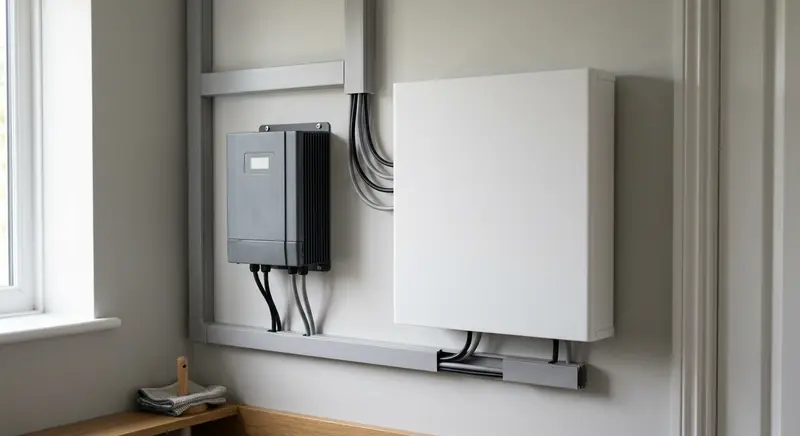
The factors that change your price
Battery capacity
Larger batteries store more energy and cost more. The right size depends on how much electricity you use in the evening and overnight, and how much your panels generate. Bigger is not always better: a battery that never fills up is money spent on capacity you will not use.
AC or DC coupling
An AC-coupled battery has its own inverter and sits alongside your existing solar inverter. A DC-coupled system uses a hybrid inverter that replaces your current one. Which is right depends on your existing equipment, its age and how your Feed-in Tariff is metered.
The age of your current inverter
Many Scottish solar systems were fitted when the Feed-in Tariff was open, and inverters usually wear out before panels do. If yours is near the end of its life, replacing it with a hybrid inverter at the same time can be worth considering.
Backup during power cuts
Some batteries can keep selected circuits running in a power cut. This needs extra switching equipment, which adds to the cost. It is popular with rural and island homes at the end of long overhead lines.
Your consumer unit and wiring
Older fuse boxes sometimes need upgrading to meet current wiring regulations before a battery can be connected. The distance between your meter, consumer unit and the battery location also affects cabling time and materials.
Where the battery goes
A battery fitted in a garage or utility room next to your consumer unit is the simplest job. Outdoor mounting, long cable runs or awkward access in tenements and older stone houses can add time.
Network paperwork
Most domestic battery retrofits are notified to SP Energy Networks or SSEN under G98 after installation. Larger systems need a G99 application before connection, which can take longer. We handle this either way.
What is included in your written quote
Your written quote lists the battery, any inverter, backup equipment, electrical work, commissioning and network paperwork, so you can see exactly what you are paying for. Warranty and guarantee terms are confirmed in writing on your quotation.
There is no obligation after the survey. If a battery does not suit your home, we will tell you plainly.
VAT and paying for your battery
0% VAT on solar panels and batteries until 31 March 2027. This is applied automatically on your quote. Interest-free credit up to £30,000, subject to status.
We install through MCS-certified partners. Read our VAT and finance guide for more on what support may be available.
Frequently asked questions
How much does it cost to add a battery to existing solar?
Every battery retrofit is priced individually at survey because the cost depends on capacity, coupling, inverter age, backup and wiring. Your price is confirmed on your written quote with no obligation. 0% VAT on solar panels and batteries until 31 March 2027.
Why do you not publish prices online?
Publishing a single price would be misleading because every home is different. The cost depends on the battery capacity you need, whether AC or DC coupling is used, your inverter age, whether you want backup capability, and the wiring route. Your written quote shows the full breakdown.
Is finance available to spread the cost?
Interest-free credit up to £30,000, subject to status. Your price and finance options are confirmed on your written quote after a no-obligation survey. There is no obligation to take finance or to go ahead after your survey.
Does the price include installation and DNO paperwork?
Yes. Your written quote includes the battery, any inverter, backup equipment, electrical work, commissioning and all G98 or G99 DNO notification paperwork. There are no hidden costs — the price on your quote is the price you pay.
What affects the cost most?
Battery capacity is the biggest factor — a larger battery costs more. Whether you need AC or DC coupling, whether you want backup capability, and the complexity of the wiring route from your meter to the battery location all affect the price. Your survey gives an exact recommendation.