Solar battery questions from Scottish homeowners
These are the practical questions Scottish homeowners ask us most about living with a battery, from tenement flats and cold garages to island weather and selling your home. Each answer is short and direct.
For the basics on cost, Feed-in Tariff, sizing and VAT, see the quick answers on our home page. If your question is not here, call 0141 230 0198 or email info@scottishenergyefficiency.co.uk.
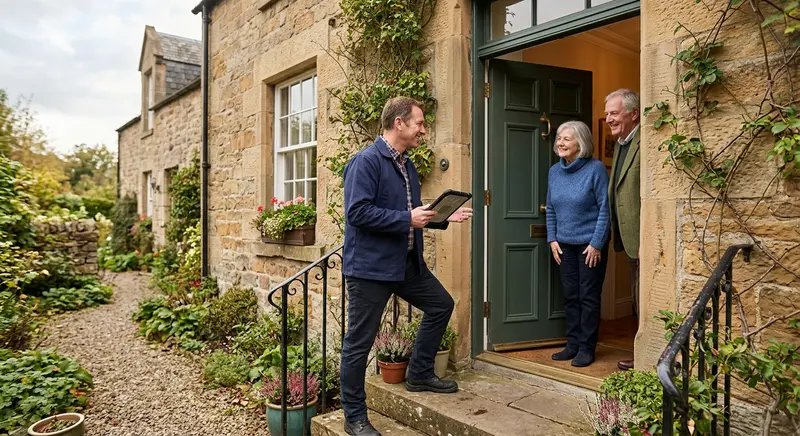
Can I add a battery if I live in a tenement flat?
Often, yes. A battery is usually fitted inside your own flat or a private store, so it rarely needs agreement from other owners. If any cabling has to cross shared areas or the roof, consent may be needed. Your surveyor checks the layout of your building and explains what applies before you commit.
Will a battery cope in a cold Scottish garage?
Every battery has an operating temperature range set by its manufacturer, and some reduce charging when very cold. An unheated garage can be fine for many models, but not all. Your surveyor checks the space, its ventilation and the manufacturer guidance, then recommends the most suitable spot in your home.
Can my battery charge from the grid overnight?
Yes, most modern batteries can be set to charge from the grid during cheaper off-peak hours, then power your home through the evening. This is useful in Scottish winters, when solar generation is low. Whether it suits you depends on your tariff and usage, which we look at during your survey.
Do I need to change my solar inverter?
Not always. An AC-coupled battery comes with its own inverter and works alongside the one you already have, so your existing inverter can stay. If your current inverter is failing, a hybrid inverter that runs both panels and battery may make more sense. Your surveyor explains both options.
Can I add more battery storage later?
Many battery systems are modular, so extra units can be added later if your needs change, for example after buying an electric car. Not every model expands, and some limit how many modules one inverter can run. If you think you may want more storage, tell us at survey so we recommend a suitable system.
Does a home battery make any noise?
Batteries themselves are close to silent. The inverter and any cooling fan can make a low hum, usually only noticeable close by when charging or discharging hard. This is one reason batteries are often fitted in a garage, utility room or on an outside wall rather than a bedroom or living area.
Can a battery be fitted outside in Scottish weather?
Some batteries are rated for outdoor installation and can be wall-mounted outside, which suits homes without a garage. Exposed coastal and island sites face wind-driven rain and salt air, so the location and mounting matter. Your surveyor checks the manufacturer rating and suggests a sheltered position where possible.
Does a battery need Wi-Fi or an app?
A battery will work without internet, but a connection lets you see what it is doing, adjust charging times for your tariff and receive software updates. Most systems connect to your home broadband and use a monitoring app. A good Wi-Fi signal where the battery is fitted helps, and we check this at survey.
Should I tell my home insurer about a battery?
It is sensible to tell your home insurer when you add a battery, as it is a permanent electrical installation that adds value to your property. Most insurers simply note it on your policy. You will receive installation paperwork and certificates after commissioning, which you can share with them if asked.
What happens if I sell my house?
A battery is a fixed part of the electrical installation, so it normally stays with the house. Keep your installation certificates, warranty documents and app login details to pass on to the buyer. If you have Feed-in Tariff payments, the new owner will need to contact the FiT supplier to transfer them.
Can I get paid for exporting battery power?
Export payments come from your electricity supplier under the Smart Export Guarantee or their own export tariff, and the rules differ between suppliers. Some allow you to export stored battery power, while others pay for solar export only. Check your supplier terms, and we will explain how your setup affects this.
Do you install batteries on Scottish islands?
Island and remote homes are on the SSEN network and often face longer lead times for visits, harsher weather and occasional grid interruptions. A battery with backup can be especially useful there. Contact us with your postcode and we will confirm whether we can arrange a survey and installation for your area.