How a home battery works with your existing solar panels
Solar panels generate most of their electricity in the middle of the day, when many homes use the least. Without a battery, that surplus is exported to the grid. A battery stores it so you can use your own solar power in the evening instead of buying it back.
This guide explains what is installed, the difference between AC and DC coupling, and how your Feed-in Tariff is kept safe.
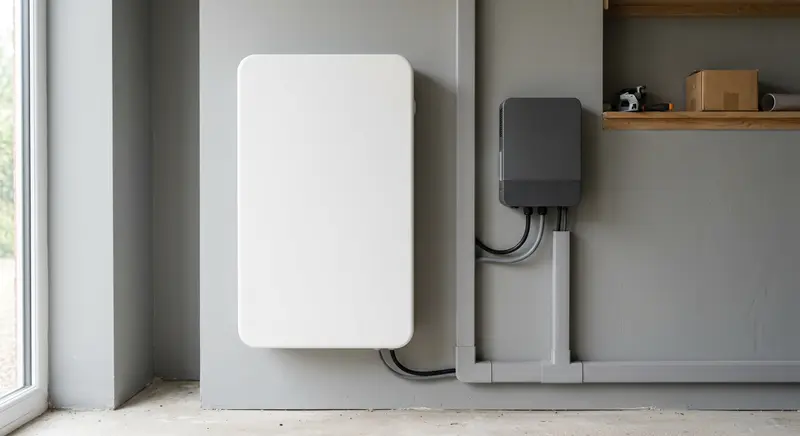
What is installed
The battery
A wall-mounted or floor-standing unit, usually using lithium iron phosphate (LiFePO4) cells. It is typically fitted in a garage, utility room or on a suitable outside wall.
An inverter
Batteries store direct current (DC) but your home runs on alternating current (AC). An inverter converts between the two. Depending on your system, this is either a separate battery inverter or a hybrid inverter that also runs your panels.
A meter or current clamp
A small sensor near your electricity meter tells the battery when your home is importing or exporting, so it knows when to charge and when to supply power.
Optional backup switching
If you choose a battery with backup, extra equipment lets it keep selected circuits running during a power cut.
Monitoring app
Most systems connect to your broadband so you can see your solar, battery and grid use on your phone and set charging times.
AC coupling vs DC coupling
An AC-coupled battery connects on the AC side, after your existing solar inverter. Your panels and inverter carry on exactly as before, and the battery has its own inverter. This is the most common way to add a battery to an older system, and it works with most inverter brands.
A DC-coupled system uses a hybrid inverter connected to both your panels and the battery. It replaces your existing inverter and avoids one conversion step. It can make sense when your current inverter needs replacing anyway, but it changes how your solar system is wired, so the effect on Feed-in Tariff metering must be checked first.
Keeping your Feed-in Tariff safe
Feed-in Tariff payments are based on your generation meter, which records what your panels produce. With an AC-coupled battery, that meter stays in place and keeps recording solar generation only, so the way your FiT is measured does not change. Your surveyor checks your metering and confirms the approach in writing before any work starts.
A typical day with a battery in Scotland
In the morning, your panels start generating and power your home first. Any surplus charges the battery instead of going to the grid. In the evening, when the panels stop, the battery supplies your lights, cooking and appliances. Once the battery is empty, you draw from the grid as normal.
In winter, short days mean less solar to store. Many households set the battery to charge from the grid on a cheaper overnight tariff, then use that stored energy at busier times of day.
From enquiry to switch-on
After a no-obligation survey, you receive a written design and quote. Once you go ahead, we arrange installation through our MCS-certified partners, notify your network operator, commission the system and set up the app with you before the engineer leaves.
Frequently asked questions
How does a battery work with existing solar panels?
A battery stores surplus solar energy that would otherwise be exported to the grid, so you use it in the evening instead. An AC-coupled battery connects after your existing inverter, so your panels and Feed-in Tariff metering carry on exactly as before.
What is AC coupling?
AC coupling connects the battery after your solar inverter, on the AC side. Your generation meter keeps recording solar output exactly as before, so your Feed-in Tariff payments are protected. It works with any inverter brand and age, making it the safest option for most retrofits.
How long does installation take?
Most battery retrofits are completed in a single day — typically 4 to 6 hours. Our engineers work cleanly and efficiently, and your system is live before they leave. There is no need to take time off work.
What is G98 or G99 DNO notification?
When you add a battery, your Distribution Network Operator must be notified. G98 covers most domestic systems under 16A per phase. G99 applies to larger systems. In Scotland, this is SP Energy Networks or SSEN. We handle all the paperwork for you.
Can a battery charge from the grid overnight?
Yes. Most modern batteries can charge from the grid on a cheaper overnight tariff and discharge during the evening peak. This is especially useful in winter when solar generation is low. Your surveyor checks your tariff and sets up the charging schedule.